The concept of a “perfect” nose is often influenced by current trends and deeply ingrained personal ideals of beauty. However, true beauty in rhinoplasty is not defined by a universal shape, angle, or fashion. It is characterized by how the nose complements your facial features, anatomy, and heritage, and how seamlessly the result integrates with your individual identity.
Liebertz Plastic Surgery at Yarrow Bay approaches rhinoplasty with both artistic vision and surgical expertise. Our practice is led by Dr. Daniel J. Liebertz, a double board-certified facial plastic and reconstructive surgeon who has completed advanced training in facial plastic surgery.
With extensive experience in both aesthetic refinement and nasal function, Dr. Liebertz's practice focuses exclusively on facial procedures, where nuance is crucial and enduring results depend on structure, proportion, and moderation. Through this perspective, precision guided by experience, the idea of a single “perfect” nose begins to evolve.
The “Perfect Nose” Isn’t Quantifiable
Traditional facial aesthetic models, such as neoclassical canons or golden ratio-based proportions, were developed using limited population samples. Modern research shows these systems:
- Do not reliably apply across different ethnic groups
- Often overlook skin thickness, cartilage strength, and soft tissue dynamics
- Fail to account for how the nose relates to the entire face
In rhinoplasty, “beautiful” usually means:
- Balanced proportions (the nose fits the eyes, lips, chin, and face shape)
- Natural lines and light reflection create smooth transitions, not harsh edges
- Stable structure that holds up over time to support healthy breathing
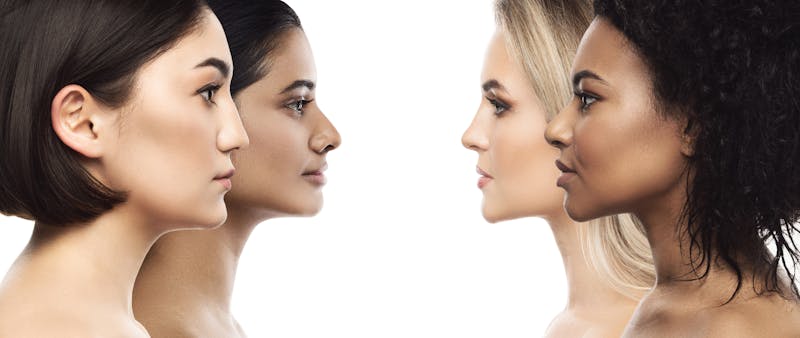
What’s Considered a Beautiful Nose is Not Universal
Nasal aesthetics are shaped by culture, ethnicity, geography, and social context. Decades of aesthetic research confirm that preferences vary across populations, particularly in features such as:
- Nasal width and base shape
- Tip projection and definition
- Dorsal height and contour
- Nasolabial angle (the relationship between the nose and upper lip)
Simply put, aesthetic ideals are culturally constructed, and attempting to impose standardized nasal ratios can compromise both aesthetic satisfaction and personal identity. The most successful rhinoplasty result is not one that conforms to a global standard or erases defining features; rather, it:
- Respects your ethnic and cultural identity
- Preserves character and facial expression
- Creates balance among your unique facial features
- Feels natural, cohesive, and authentically yours
How We Determine the Perfect Nose Shape For You
Your initial consultation at Liebertz Plastic Surgery at Yarrow Bay will help you determine whether you want refinement or reinvention.
Refinement may include:
- Smoothing a bump
- Improving symmetry
- Defining the tip
- Subtle deprojection
Alternatively, reinvention offers a noticeably different size/shape or a more dramatic profile change.
Next, we’ll discuss how we’ll preserve the nasal features that you never want to lose. Some examples include:
- Ethnic identity
- A specific “family resemblance”
- A natural look that doesn’t announce surgery
With this information, we’ll create your surgical blueprint, which considers:
- Front view: Symmetry, width, tip definition, natural contour.
- Profile view: Dorsal line, projection, rotation, overall balance.
- Base view: Nostril shape, airway, subtle refinement without distortion.
The “Perfect Nose” Is the One That’s Perfect For Your Face
If your goal is:
- to look exactly like someone else,
- to chase a trend,
- or to pursue a nose that ignores your facial structure,
… you’re more likely to feel disappointed, even if the rhinoplasty surgery is technically successful. The best rhinoplasty outcomes are those that make you look like your best self, and at Liebertz Plastic Surgery at Yarrow Bay, that philosophy is our guiding principle.
If you’re ready to stop chasing “perfect” and start designing what’s beautiful for you, schedule a private consultation today.