
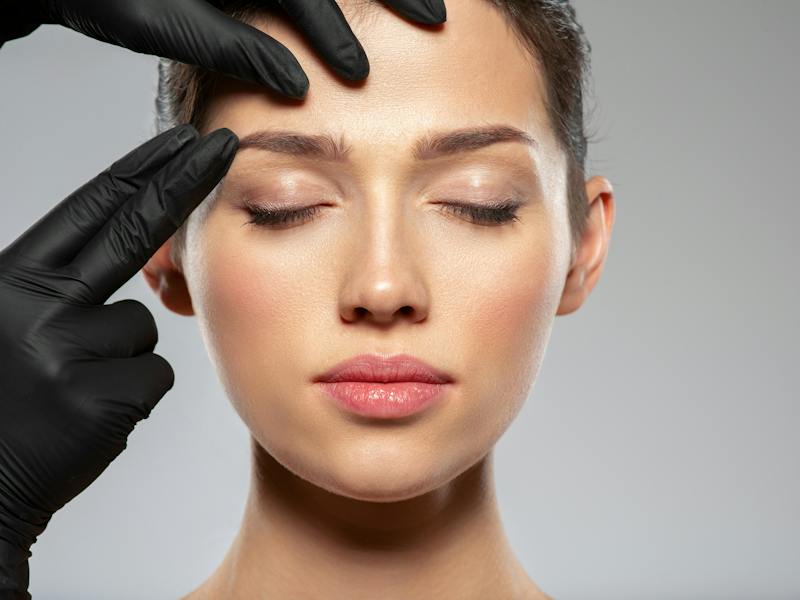
A well-performed brow lift looks natural. The "surprised" or "deer in the headlights" expression people worry about comes from over-elevation, particularly lifting the inner (medial) brow too high or raising the entire brow straight up without regard for its shape. When the surgeon restores the brow's natural arch, lifting the tail more than the head, the result reads as rested and alert rather than startled.
At Liebertz Plastic Surgery at Yarrow Bay, double board-certified facial plastic surgeon Dr. Daniel J. Liebertz approaches the upper face with the precision of a fellowship-trained surgeon and the eye of a trained artist; before medicine, his academic background was in Studio Art. In this blog, Dr. Liebertz explains why some brow lifts look overdone, what research says about natural brow position, and how a brow lift in Seattle can refresh your expression without changing who you are.
Why Do Some Brow Lifts Look Surprised?
Brow lifts look surprised when the brows end up too high, too evenly arched, or peaked in the wrong place. A systematic review published in Plastic and Reconstructive Surgery Global Open identified the main culprits behind an unnatural, surprised appearance after brow rejuvenation.
These include:
- Excessive elevation of the medial brow: Lifting the inner brow widens the gap between the brows and creates a perpetually questioning look.
- A flat or medially placed brow peak: The highest point of an attractive brow typically sits toward the outer third, not near the center.
- Raising the entire brow uniformly: Pulling everything straight up ignores the brow's natural slope and contour.
Each of these problems stems from treating the brow lift as a pure elevation procedure. In reality, the most natural results come from reshaping and repositioning, not simply lifting as high as possible.
How Does the Brow Actually Change With Age?
The brow ages in a way that surprises many patients: the inner brow often rises over time, while the outer tail sags. The same systematic review and meta-analysis found that eyebrow height increased with age at the level of the inner corner of the eye and mid-pupil, while it remained stable at the outer corner. Researchers advised surgeons to keep these patterns in mind when planning brow rejuvenation.
An earlier 2009 study in Plastic and Reconstructive Surgery reached a similar conclusion after comparing women in their 20s with women in their 50s. The authors described a paradoxical elevation of the brows with age and concluded that surgically raising the mid and medial brow produces results that look neither youthful nor aesthetically pleasing.
The practical takeaway is significant. Because the outer brow is usually what descends and creates hooding over the eyelids, Dr. Liebertz focuses his evaluation on the lateral brow and the overall arch rather than the brow's absolute height.
What Makes a Brow Lift Look Natural?
A natural brow lift restores shape and proportion while leaving facial expression intact. Rather than chasing maximum elevation, the goal is a brow that looks like your own from several years earlier.
Several factors contribute to a natural result:
- Lateral emphasis: Lifting the tail of the brow more than the head recreates a gentle upward slope and opens the eye area.
- Conservative elevation: Small changes measured in millimeters often make the biggest visual difference.
- Symmetry planning: Most people have one brow that sits higher than the other, so careful pre-operative measurement matters.
- Hairline awareness: Some techniques raise the hairline, so incision placement must account for forehead height.
Dr. Liebertz selects among several approaches based on each patient's anatomy, including endoscopic, temporal, and pretrichial techniques. Each one positions incisions and lift vectors differently. Our article on brow lift techniques explains how these options compare.
Is It My Brow or My Eyelids?
Many patients who believe they need eyelid surgery actually have a descended brow, and vice versa. When the outer brow drops, it pushes skin down onto the upper eyelid, creating a hooded look. Removing eyelid skin alone in that situation can pull the brow even lower.
During your consultation, Dr. Liebertz assesses brow position and upper lid skin together. Some patients benefit most from a brow lift, others from upper eyelid surgery, and some from a combination. Addressing the right structure is one of the most reliable ways to avoid an unnatural outcome.
Choosing the Right Surgeon for a Natural Brow Lift in Seattle
The surgeon's training and aesthetic judgment have more influence on a natural result than any single technique. The American Society of Plastic Surgeons lists an elevated hairline, facial asymmetry, and the possibility of revision surgery among recognized brow lift risks, all of which relate directly to planning and execution.
Dr. Liebertz is board certified by both the American Board of Otolaryngology–Head and Neck Surgery and the American Board of Facial Plastic and Reconstructive Surgery. After residency, he was one of 46 surgeons worldwide chosen for a facial plastic surgery fellowship at Emory University, where he trained under leading facial plastic surgeons.
When evaluating any surgeon for a brow lift in Seattle, ask to see results from patients with anatomy similar to yours. Our before-and-after gallery and patient testimonials offer a look at Dr. Liebertz's aesthetic approach.
Brow Lift FAQs
How long does it take for a brow lift to look natural?
Brow lift results typically begin looking natural as swelling subsides over the first one to two weeks. The brows may appear slightly high at first, then settle into their final position over the following weeks. Most patients see their refined result by around six weeks.
What are the risks of a brow lift?
Brow lift risks include bleeding, infection, anesthesia risks, numbness or itching, hair loss around incisions, facial nerve injury, asymmetry, an elevated hairline, unfavorable scarring, and the possibility of revision surgery, according to the American Society of Plastic Surgeons. Dr. Liebertz reviews each of these during your consultation.
Can an over-elevated brow lift be corrected?
An over-elevated brow can sometimes be lowered or reshaped with revision surgery, though correction is more complex than getting the position right the first time. This is one reason conservative planning is so important.
Can Botox create a surprised look?
Botox can occasionally create a temporary surprised or arched look if the forehead and brow muscles are treated unevenly. Because neuromodulators wear off within a few months, the effect is short-lived and can often be adjusted. Our blog on brow lift vs. Botox explains when each option makes sense.
Will people be able to tell I had a brow lift?
When the brow is restored to a natural shape and height, most people notice that you look more rested rather than "lifted." Incisions are typically placed within or along the hairline, where they are designed to be inconspicuous once healed.
Natural Brow Lift Results With Dr. Liebertz in Kirkland
A brow lift in Seattle should leave you looking refreshed, open, and unmistakably yourself, never startled. With double board certification, elite fellowship training, and a Studio Art background that informs his sense of proportion, Dr. Liebertz designs every brow lift around natural shape rather than maximum height. Contact Liebertz Plastic Surgery at Yarrow Bay or call 425-553-2009 to schedule your consultation at our Kirkland practice.
This information is provided for educational purposes only and does not replace a consultation with a board-certified facial plastic surgeon. Outcomes, risks, and suitability vary from patient to patient.
Sources
- American Society of Plastic Surgeons. "Brow Lift Risks and Safety." https://www.plasticsurgery.org/cosmetic-procedures/brow-lift/safety
- Asaad M, Kelarji AB, Jawhar CS, et al. "Eyebrow Height Changes with Aging: A Systematic Review and Meta-analysis." Plastic and Reconstructive Surgery Global Open, 2019;7(9):e2433. https://pmc.ncbi.nlm.nih.gov/articles/PMC6908395/
- "Changes in Eyebrow Position and Shape with Aging." Plastic and Reconstructive Surgery, 2009;124(4):1296–1301. https://pubmed.ncbi.nlm.nih.gov/19935315/